





Thermal store stratification
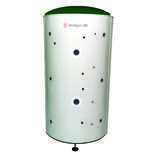
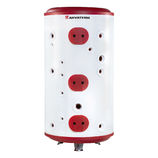
Stratification is another word for layering, and this is exactly what you want the water in your tank to do. You would like the hottest water to be at the top of your thermal store the cooler water at the bottom of the tank, and as small as possible a mixing layer between the two.
The reason for this is that the thermal store, as its name suggests, stores heat in the form of hot water from. You might store up heat from your boiler stove in the evening, from solar panels in the daytime, from a heatpump, etc. You can then use this heat later on when it is needed, the advantage being that you do not need to use all the energy at the time when it was created. The hot water at the top of the thermal store will be used for your hot water and heating. If the water at the top starts out at, say, 75 C, then it will easily provide you with hot water for a long time. As you use the hot water the idea is that the layer of hot water gets smaller rather than the whole layer cooling down. This means that the tank can provide usable hot water for a long time.
As you heat the water in the tank up the idea is that the layer of hot water at the top gets bigger (and the cold water layer at the bottom gets smaller).
If the temperature of the water in the tank was totally uniform then the tank would stop providing usable hot water long before the tank with good stratification.
As an example lets imagine we have a 1000lt thermal store which has a 250lt layer of hot water at the top which is at 80 C. The rest of the water in the tank is at 20 C. This tank will continue to provide hot water for some time, we are talking quite a lot of showers. Now lets mix the water in the tank up. By mixing the 250lts at 80 C and the 750lt at 20 C the temperature of the whole thermal store is now 35 C, and will not provide us with hot water - well not hot enough for me anyway!
Heat transfer coils for Domestic Hot Water (DHW) in the tank are run so that the water enters at the bottom of the coil. This means that when the water gets near the top of the coil that it has already picked up a fair bit of heat from lower down in the tank, which means that it cools the water at the top of the tank less.
Similarly in solar thermal stores with twin solar coils the hot water from the solar panels enters at the top of the coil and runs downwards. This means that most of the heat is transferred through the upper part of the coil into water higher up in the tank.
Adding heat to the bottom of a thermal store can lead to mixing because it heats the cooler water at the bottom of the tank, which then rises and creates a current. These currents can get pretty fast and so our thermal stores have a baffle inside to help reduce these currents. The baffle separates the tank into a top and bottom sections. In the middle of the baffle is a hole which allows the hottest water from the lower half of the tank up into the top, but minimises the currents in the top half to reduce mixing.