Stove room ventilation regulations
In Document J, pages 17-21 and 29
Ventilation for stoves
Stoves need a supply of air to burn and to let the flue gases move up and out of the chimney or they will not work. With no air supply to the room the stove will not light well and smoke is likely to come out into the house. The smoke will not be able to be drawn up the chimney as this requires an upward air movement which is not possible if there is no source of air - it has to come from somewhere.
If your stove smokes or does not burn very keenly, but this improves when you open a window, then this is a sign that you need to install some ventilation. Read more about this on our smoking stoves page. Sometimes enough air may be coming into your home already no so dedicated ventilation might not be necessary.
Stove ventilation - the regs
Ventilation rates to the stove are now based on the air permeability of the house as well as the rated output of the stove.
| Stove with a draught stabiliser fitted |
| |
| Stove with no draught stabiliser fitted |
|
A house built before 2008 is unlikely to have an air permeability of; 5.0m/h.m unless it has had a lot of work done to it (eg double glazing throughout, draught proofing to doors and letterboxes, etc). A house built after 2008 should have an air permeability test result which you can have a look at.
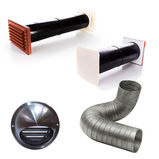
An increasing number of stoves (for example all of our Opus stoves) can be connected to an external air supply so that they take they air they need to burn from outside the house. We carry external air ventilation kits and ducting for just this purpose.
A room vent should be placed in such a way that it cannot be easily blocked and so that house residents are not tempted to block it off to reduce draughts or noise.
It can be a good idea to place the vent close to the stove. Because the stove draws the air that it needs for combustion through the vent there will be a draught from the vent to the stove. If the vent is close to the stove then draughts are reduced and the house stays warmer.
If there is a mesh to guard against pest/mice etc coming through the vent then the mesh size must be no less than 5mm.
Positioning ventilation for a stove
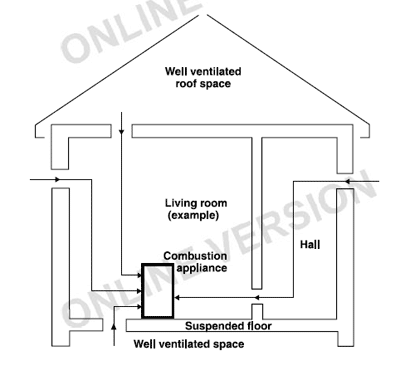
The vent can be placed in the walls of the room or in the floor. The vent does not even have to be in the same room as the stove - for example ventilation can be provided to another room or loft space which itself has permanent ventilation to the outside.
Stove room ventilator
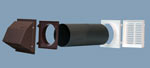
We supply stove room ventilators which can be fitted simply using a 5" core drill. They incorporate a series of baffles inside to reduce wind noise and they comply with the building regulations for almost any solid fuel stove that you want to fit. For more information please see our stove room ventilation page
If you need to install a stove into an airtight house with no vent to the room then we have a solution for you, see our stoves for airtight houses page