What are wood pellets?
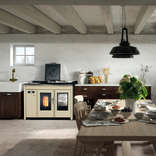
Wood pellets are the future of wood heating. Because wood pellets have a consistent size, energy content and moisture content they allow you to use them in automated stoves and boilers, opening up whole new world's of possibility. Wood pellet stoves and boilers will light themselves when they are needed, typically using a small electric ignitor which comes on for a short while. The oxygen supply can be well controlled meaning that pellet stoves and boilers get very efficient and burn with low emissions. Wood pellet stoves are usually around 80-90% efficient. Because they are so efficient pellet stoves make very little ash - 2% or less of the volume of pellets burnt becomes ash and when your sweep comes to clean your chimney they will definitely notice the difference.
Wood pellets are fairly easy to move mechanically because they act a little like a liquid. Moving pellets around is done using an auger, which is a big screw that turns, feeding the fire as needed. This lets a pellet stove regulate it's own heat output. Auto-ignition is standard and pellet stoves can also be connected to heating controllers so you are getting something that burns wood but functions much more like a gas or oil boiler.
How are wood pellets made?
Wood pellets are made of compressed sawdust or wood dust. Sometimes this is a waste product from other industries (e.g. sawmills). The pellets are held together by the natural lignin in the wood - no glue is needed. Lignin makes up about a quarter to a third of dry wood. It strengthens the wood as well as having water proofing properties. It is also a good fuel. Wood pellets have a very low moisture content, typically 6-10%. That means that wood pellets are a very good source of energy because very little of the energy in the pellets is used to evaporate moisture. Pellets are either made using purpose built machinery or they can also easily be made using cow feed machines as the process is very similar. Indeed a cow feed mill may make cow feed for half of the year and then produce wood pellets for the rest of the year!
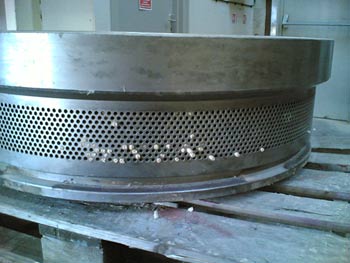
Wood pellets are formed by forcing wood dust through these holes
under extreme pressure. Photo: the Energy Crops Company Ltd.
The wood is first made into a dust of a consistent size using a hammer-milling machine. The sawdust is then compressed under great pressure and forced through holes (a bit like making mince). This is a hot process and the natural lignin in the sawdust melts and binds the dust together, holding the pellet in shape and giving it that characteristic sheen on the outside. The pellets come out of the machine at around 90 degrees C, cool, and harden off.
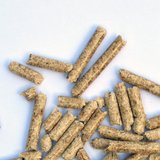
Wood pellets are cylindrical and for most domestic uses have a diameter of 6-8mm. The pellets are a dense form of fuel which means that they have a higher energy content than wood and take up less space.
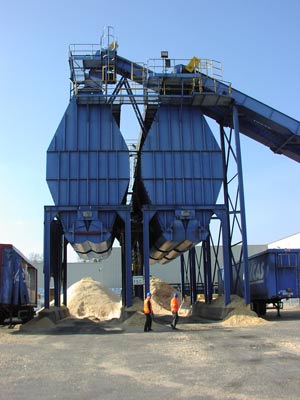
Photo: the Energy Crops Company Ltd.
Obviously pellets take energy to produce - the lion's share of this energy is in drying the sawdust, so it is much more efficient to work with wood that is already dry. The energy used in the production of pellets as a percentage of the total energy in the pellets can be as low as 1.62% when using dry wood, but up to 17.6% if using wet wood that needs drying.
Wood pellets are a renewable fuel
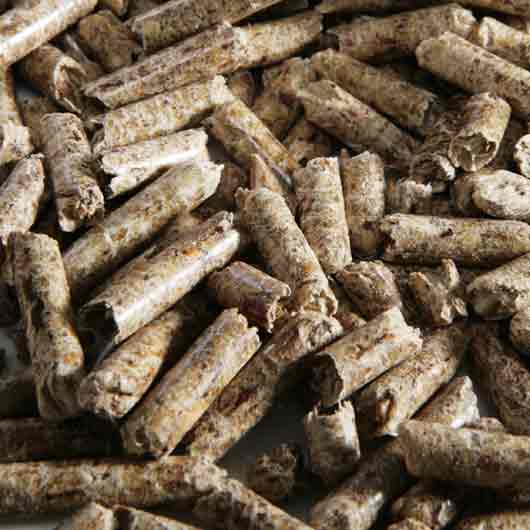
Photo: Forest Fuels Ltd.
Wood pellets are a renewable source of fuel. As long as the wood is sourced from a working forest (i.e. one where more trees are planted to replace trees cut down) then the wood is renewable. To get more wood you simply grow more trees. When the tree grew it used energy from the sun to convert CO2 from the atmosphere into wood, letting it grow. When the wood is burnt the carbon dioxide emitted is this same CO2 that had been taken out of the atmosphere by the growing plant. So that means that overall there is no change in the levels of atmospheric CO2. If the tree were left to die naturally then animals and plants would 'eat' it eventually releasing the same amount of CO2 back into the atmosphere. Burning the wood just speeds up the process. Even allowing for carbon dioxide emissions produced by fossil fuels used to make the energy needed for planting, harvesting, processing and transporting the fuel, replacing fossil fuel with wood fuel will typically reduce net CO2 emissions by over 90%.
Are wood pellets carbon neutral?
Wood and wood pellets are not carbon neutral. This is because it takes some energy to plant, harvest, process and transport the pellets, and this energy is usually derived from fossil fuels. The manufacturing of wood pellets takes a relatively high amount of energy, especially when compared to wood chips. If the whole process were powered by carbon neutral energy sources then wood pellets would be carbon neutral. Compared to other fossil fuels wood pellets (and wood) still result in MUCH less CO2 production.